


A healing journey
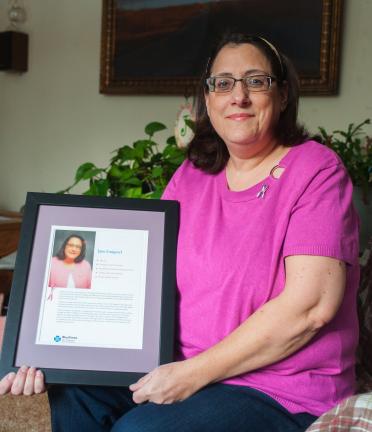 BOB FORD/TIMES NEWS Jane Longazel of Jim Thorpe holds a framed certificate honoring her inclusion in Blue Cross of Northeastern Pennsylvania's Gallery of Hope.
It was Monday, Sept. 22, 1997, and Jane Longazel worked hard to hold a diabetic teenaged boy as a co-worker gave him a needed dose of glucose. She felt an unusual pressure in her chest. But she shrugged it off, figuring it was from the physical exertion.
Later, she felt a knob of tissue at the spot. But Longazel, of Jim Thorpe, put off seeing a doctor for a week so as not to disrupt her work schedule.
Needle biopsies revealed the lump was cancerous. The doctor advised a lumpectomy, but Longazel sought a second opinion, and went to the Hospital of the University of Pennsylvania in Philadelphia.
The consensus was that her breast needed to be removed, and a mastectomy was scheduled for the day after Thanksgiving. But over the weekend, her breast became inflamed, swollen and sore, and the skin began to dimple.
The head of oncology diagnosed her condition as inflammatory breast cancer; Longazel's survival prognosis fell to 33 percent.
Ever practical and calm, her first thought was, "OK. I'll deal with it."
Strength drawn
from faith
Longazel was the only woman in her family who was single and without children. She's grateful that it was she who contracted cancer.
"Thank you, Lord for choosing me," she says. "He chose wisely."
Her deep faith has been her rock throughout her healing journey.
Shortly before her diagnosis, Longazel had bought a statue of Jesus in the Garden of Gesthemane.
"Jesus was accepting his Father's decision for him to die," she says. "This is my cross to bear. If He went through all that pain, I can manage this."
She still has the statue, in her bedroom.
"It's one of the first things I see when I wake up," she says.
The trials
of treatment
On the Friday after Thanksgiving, Longazel had surgery for the placement of a port, and had her first chemotherapy treatment.
After the first four rounds of chemotherapy, from November through January, 1998, the lump had shrunk from the size of a fist to the size of a knuckle. The mastectomy was scheduled for February.
She prepared by visualizing the procedure, the results, and even the disposal of the cancerous tissue, which she imagined floating away on a trash barge.
It helped: Longazel was prepared for the worst while not expecting the worst.
The surgery removed her breast and 18 nodes. Two remaining nodes were discovered to harbor cancer cells, and doctors decided on a stem cell transplant.
After a bone biopsy in March to rule out further spread, she began with injections to increase her white blood cells. The stem cells were harvested in April. The transplant was scheduled for May.
At one point during the process, she had a "horrific fever" for about a day and a half. She could not be given pain relievers or fever reducers. She began to hallucinate that her mother, who had died years earlier, was giving her an alcohol rub. Very soon after, her fever broke.
Longazel remained in the hospital for 19 days after the transplant, returning to work in August, 1998. The next month, she started a schedule of 45 radiation treatments that ended in October 1998.
Moving forward
Doctors kept close watch for 10 years. Last year, Longazel celebrated 16 years as a cancer survivor.
Now, she has been chosen by Blue Cross of Northeastern Pennsylvania as one of 10 breast cancer survivors to be included in the company's 14th annual Gallery of Hope.
The gallery is a traveling display to teach the importance of early detection and treatment in the fight against the disease. The gallery is available to exhibit throughout northeastern and north central Pennsylvania.
Longazel was nominated by Blue Mountain Health System Director of Fund Development Joe Guardiani at the behest of BMHS Nursing Home Administrator Alicia Silliman.
She cited Longazel's many years of volunteer work with the Lehighton Area Lioness Lions Club, the Amazing Grace Spay and Neuter Program, the Pink Light Walk, of which Longazel was a co-founder, and her decades-long career at CONCERN Treatment Unit for Boys in Mahoning Township.
"She is an inspiration to all, providing support to others who have been newly diagnosed with cancer," Silliman said. "Jane stepped up with her positive attitude, which she believes had a strong influence on her outcome."


